###theme of the competition The integration of technological innovation empowers new industries and jointly promotes the sustainable development of BRICS countries
organizational structure
1 Organizer Chinese Council of BRICS Business Council Belt and Road and BRICS International Alliance for Skills Development "Belt and Road" and BRICS Skills Development and Technological Innovation Training Center
2 Co-organizer China Invention Association China-Foreign People-to-People Exchange Center of the Ministry of Education
3 Organizer BRICS Business Council Chinese Working Group on Skills Development, Applied Technology and Innovation
4 Co-organizer Xiamen City BRICS Future Skills Development and Technology Innovation Research Institute BRICS Future (Xiamen) Technology Co., Ltd.
track-setting
The competition set up ten tracks, including intelligent advanced manufacturing, digital health and medical care, green energy and carbon neutrality, artificial intelligence integrated applications, virtual simulation and metaverse, digital agriculture and food security, aerospace information and communication technology, smart government and public governance, ecological protection and resilient cities, and exploration of future cutting-edge technologies. (Only public track related to public regulation is listed below. For other tracks, please download the attachment for details)
-
Digital health and medical care: Focusing on the full-cycle health protection and equalization of medical resources, it covers medical data interconnection platforms, remote intelligent diagnosis and treatment systems, portable disease detection equipment, public health Incident Response Service systems, and low-cost biomedical research and development. Including AI-assisted diagnosis, genetic testing, health management Digital tools, cross-border medical collaboration solutions, etc., to promote the sinking of medical services and improve public health security capabilities and response levels to public health emergencies.
-
Green energy and carbon neutrality: Focus on the entire chain of clean energy transformation and low-carbon development, covering the development and utilization of clean energy such as solar energy, wind energy, and hydrogen energy, core areas such as new energy storage technologies, smart grid construction, and cross-regional energy allocation systems. Including carbon footprint tracking and accounting in industry, construction, transportation and other industries, carbon capture and recycling technologies, green energy alternatives, etc., to help build a safe, efficient, and low-carbon regional energy cooperation network to serve the global carbon neutrality goal.
-
Digital agriculture and food security: Serving the needs of agricultural modernization and food security, covering core areas such as precision agricultural equipment, agricultural Internet of Things systems, intelligent irrigation technology, agricultural robot applications, and climate-adapted planting solutions. Including agricultural big data analysis, agricultural product blockchain traceability, cross-border agricultural product logistics optimization, intelligent monitoring and prevention of pests and diseases, grain warehousing and preservation technology, etc., through digital empowerment, agricultural productivity and anti-risk capabilities can be improved and stable food supply can be ensured.
-
Smart government and public governance: Focus on the modernization of public management and the improvement of service efficiency, covering core areas such as digital government service platforms, cross-regional government collaboration systems, intelligent decision support tools, and digital people's livelihood service ecosystems. Including multilingual government service solutions, cross-border public affairs collaboration mechanisms, smart emergency management platforms, grassroots governance Digital tools, public service equalization technical support, etc., we optimize governance processes through technical empowerment and improve public service quality and transnational collaboration efficiency.
-
Ecological protection and resilient cities: Focus on forward-looking, revolutionary and disruptive cutting-edge scientific and technological innovation areas, covering cross-disciplinary and cross-border integration technologies that are not covered by the aforementioned tracks. Including quantum computing, biomanufacturing, new functional materials, brain-computer interfaces, controllable nuclear fusion-related technologies, cross-disciplinary innovative applications, etc., encourage original innovation and future technological exploration, help seize the commanding heights of global scientific and technological competition, and provide for the future development of BRICS countries. Provide technical reserves.
competition time
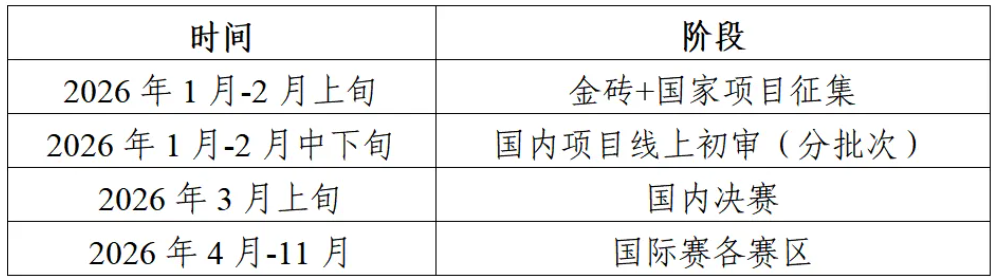
Competition arrangements
Registration
- There are no groups in the competition, and teams from enterprises, scientific research institutes, universities, and industry associations in BRICS and "BRICS +" countries are solicited for participating projects;
- Each participating event consists of 1-5 contestants (no "instructor" role);
- Only one track can be declared for each participating event;
- In 2025, gold medal events in various international divisions will no longer participate in the 2026 competition;
- Registration method (1)All participating units are requested to scan the following QR code before 12:00 on February 7, 2026 to complete the registration as required.
Preliminary review of domestic projects Organize the review of application materials in batches and screen domestic finalists.
Domestic finals arrangements The domestic finals are scheduled to be held in March 2026, and the participating projects will showcase their characteristics and innovations through live demonstrations, defenses and exhibitions. Based on the final competition results of the participating teams and based on the principle of rounding, each track will have the first prize (gold medal) accounting for 10%, and gold medals and certificates will be awarded respectively; the second prize (silver medal) accounting for 20%, and silver medals and certificates will be awarded respectively; the third prize (bronze medal) accounting for 30%, and bronze medals and certificates will be awarded respectively; other participating teams will be awarded excellence certificates. Events that win gold, silver and bronze medals in the domestic finals will be given priority to be recommended abroad to participate in international competitions (specific arrangements will be announced separately).
Preliminary review of domestic projects International competitions include Brazil, Russia, South Africa, ASEAN, Middle East, Central Asia, Guangzhou, China, China and Shijiazhuang and other competition areas, and will be held from April to November 2026 (specific arrangements will be announced separately).