###Introduction to the Awards The Green Product Award in Germany is a competition for innovative and sustainable design products and concepts, held regularly every year in Berlin, Germany. It is currently the largest award in the field of sustainable design in Europe, supported by embassies from various countries, with 35 nations or regions having participated so far. Since 2013, the Green Product Award aims to recognize sustainable innovative products and services already on the market, providing a platform for manufacturers, design studios, and agents to showcase their products in the German market.
Categories:
1. Sports
Whether it’s competitive sports, hobbies, casual fitness activities, or exercises to balance work and life, sports play an increasingly important role in our daily lives. But what materials are used in yoga mats, scuba masks, and running gear? Under what conditions are balls, running shoes, skateboards, or golf clubs made? Where are bicycles, badminton rackets, and canoes produced? Are sports equipment in clubs or schools chosen with sustainability in mind? With sports gear, we often have direct and frequent physical contact—usually while sweating—so these questions become very important. Additionally, sports products are typically status symbols and rarely inexpensive. 2. Kitchen
The kitchen is a core space in social life. Sustainable kitchen products are characterized by energy and gas efficiency, water conservation, as well as the use of sustainable materials, innovation, and ergonomic design. These are product categories designed for preparation, storage, and enjoyment—both indoors and outdoors. Examples include kitchen furniture, sinks, appliances, cooking utensils, refrigerators, kitchen accessories, ceramics, tableware, cleaning products, storage containers, and more. 3. Buildings and Small Houses
How will we live and work in the future? If 40% of energy consumption comes from buildings, urban densification will drive up real estate and rent prices, while changing household and working conditions have made traditional home purchases obsolete. It’s time to explore new approaches! In this category, look for sustainable, modular, or even temporary buildings—existing solutions and concepts. 4. Fashion
Clothing is our second skin. Yet the fashion industry remains one of the most environmentally harmful sectors. Innovative examples of sustainable design are needed to change this situation and develop new processes, materials, cutting-edge dyeing techniques, and usage concepts. The choice of production locations and the ability to repair and recycle them also play a crucial role. This category features designs and new collections for coats, jackets, cloaks, dresses, streetwear, swimwear, underwear, accessories, and jewelry. 5. Beauty and Personal Care
Sustainable personal care products such as perfumes, cosmetics, face masks, plasters, creams, shower products, deodorants, hair care items, sanitary products, razors... remain a niche market despite steady growth in market share. Winners in this category have one or more of the following features, such as use of natural ingredients, vegan options, no animal testing, and absence of synthetic dyes and fragrances. 6. Offices
Creating inspiring work environments is a challenge, especially when it comes to new forms of work. Therefore, this category includes services for planning sustainable workspaces. Of course, equipment should avoid negative environmental impacts, use healthy materials, and energy-efficient devices are recommended. Components that enhance comfort and user satisfaction—such as good sound and lighting—also help maintain health and improve performance and productivity. If these solutions and concepts can be flexibly applied and benefit over their entire lifecycle, they can offer economic advantages. Lounges, desks, chairs, meeting areas, soundproofing, relaxation islands, flooring, lighting systems, and any technical equipment all require consumables to foster a new work culture. 7. Children
Children are our legacy for the future, and in fact, all children deserve our attention because a healthier world should be our priority. We have a dedicated category focused on everything related to children’s growth, featuring concepts and solutions with great materials that have educational value as they grow up—whether in terms of size, type, customization, or modularity. We’re looking for eco-friendly furniture, toys, tableware, clothing, and equipment, as well as games and projects that spark interest in a sustainable lifestyle and help them grow into active green advocates. Register your products or concepts now to inspire and support our children! 8. Building Components
Although the “Building” category is specifically for buildings themselves, it seeks sustainable building components related to the buildings (existing solutions and concepts) within this category. In the second step, the most comprehensive components are integrated into a prototype of a green modular microhouse. This category applies only to floors, walls, insulation, exterior wall or roof systems, bathrooms and kitchens, supply technologies (sanitation, ventilation, heating, and energy), as well as building automation systems at the product and service levels. 9. Mobility
Creating an inspiring working environment is a challenge, especially when it comes to new forms of work. Therefore, this category includes services for planning sustainable working environments. Of course, equipment should avoid having a negative impact on the environment, use healthy materials, and energy-efficient devices are recommended. Components that enhance comfort and user satisfaction—such as good acoustics and lighting—are also suitable for maintaining health and improving performance and productivity. If these solutions and concepts can be used flexibly and bring long-term benefits throughout their lifecycle, they can be economically advantageous. Lounges, desks, chairs, meeting areas, soundproofing materials, relaxation islands, flooring, lighting systems, and any technical equipment all require consumables to foster a new work culture. 10. Freeform
The Freeform category is for submissions that cross the boundaries of other categories, span multiple industries, or simply do not fit into other categories. Sustainable cross-sectoral developments include, for example, solutions and concepts from forestry, agriculture, and horticulture, automation innovations, artificial intelligence, supply chain traceability tools, carbon dioxide emission calculators, recycling systems, recovery mechanisms, and production equipment. 11. Packaging
Whether it’s product packaging, food packaging, medical packaging, or transportation packaging... The EU generates 910 million tons of packaging waste each year, which shows the huge potential impact of sustainable packaging.!The submissions in this category are characterized by material innovation, reduced material usage, sustainable coloring or coating methods, recycling systems, recyclability, compostability, and traceable and transparent supply chains. 12. Interior and Lifestyle
People spend most of their time indoors, which is why we refer to it as the “generation of interior design.” This lifestyle can lead to indoor air pollution (for example, through material evaporation). The internal environment around us not only affects our health but also our mood and sense of well-being. Additionally, smaller apartments, home offices, and more frequent relocations have created different requirements, reshaping our living spaces and their furnishings. To create future living spaces—including balconies/terraces and gardens—people are seeking eco-friendly, energy-efficient, and repairable furniture, fixtures, electrical appliances, lighting, accessories, paints, and other solutions and concepts. 13. New Materials
The raw material reserves on our planet are steadily decreasing, while carbon emissions and greenhouse gases continue to rise. Therefore, from the perspective of a circular economy, the efficient use and protection of resources have become urgent priorities. This approach allows new materials to be created at any stage of their life cycle, with the material itself serving as its source—all you need to do is think about starting and ending. Factors such as resource consumption, origin, availability, transportation routes, lifespan, or material properties (weight, elasticity, conductivity, etc.) provide further guidance. We are expanding our databases of materials and prototypes (which are very important) and looking forward to new material applications, such as those derived from mushrooms, fruits, algae, pine needles, seaweed, ash, which can be used in construction, interior design, fashion, mobility, packaging, and many other areas. 14. Consumer Goods
Fast-moving consumer goods influence our daily lives. Many of them are used regularly, and most are consumed, affecting our health and the environment. Their packaging also accounts for a large portion of total packaging waste. As such, we are seeking clean products, cosmetics, toiletries, foods, and beverages that can transform consumers’ purchasing behavior toward more ethical, environmentally friendly options that may even be locally produced.
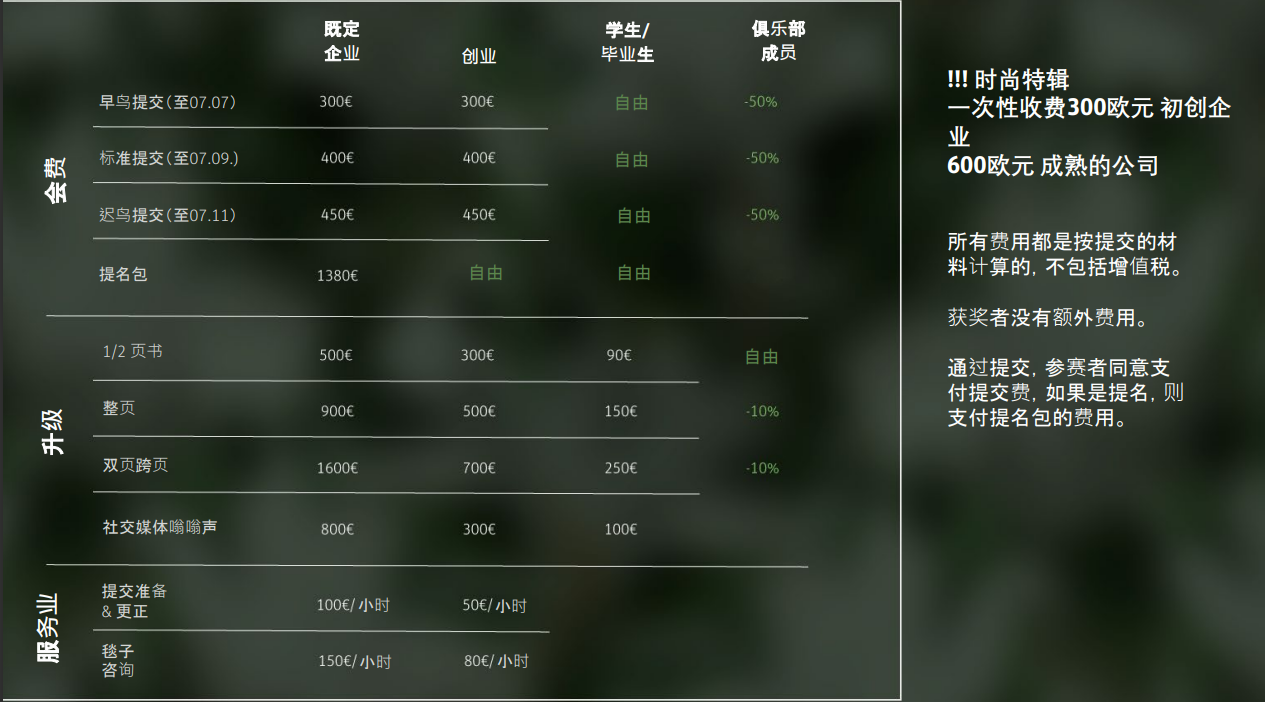
Entry Fee:
Awards Benefits:
Benefits for Nominees
-
Nominees receive unrestricted advertising rights.
-
A certificate of award.
-
A profile of the project in the sustainable catalog. Additional benefits for other winners and best-in-category entries
-
Winner/best-in-category award—sealed.
-
Project and company profiles displayed in the Green Product Awards gallery for one year. 3>Participation in the Green Product Audience Awards (50,000 votes per year).
-
Feature of some projects in partner publications. 5>Opportunity to be included in the “Green Trends Book” (250,000 readers). 6>Use of award-winning press coverage and content for own PR and social media campaigns.
Competition Timeline:
2023年7月7日:Early-Bird报名截止
July 9, 2023: Deadline for standard registrations 2023年7月11日:Late Bird报名截止
July 12, 2023: Announcement of nominees July 12, 2023 – January 22, 2024: Public voting & evaluation March 2024: Award ceremony