Plan for the 2023 Call for Typical Cases of Synergistic Pollution Reduction and Carbon Emission Cutting
Actively addressing climate change and pursuing green, low-carbon development has become an international trend. During the 14th Five-Year Plan period, China’s ecological civilization construction has entered a critical stage focused on carbon emission reduction as a key strategic direction, aiming to promote synergistic pollution reduction and carbon emission cutting, drive comprehensive green transformation of economic and social development, and achieve qualitative improvement in ecological environment quality. China has set the goal of peaking carbon emissions by 2030 and achieving carbon neutrality by 2060, making accelerated green, low-carbon development a national strategy and a historical choice for corporate transformation.
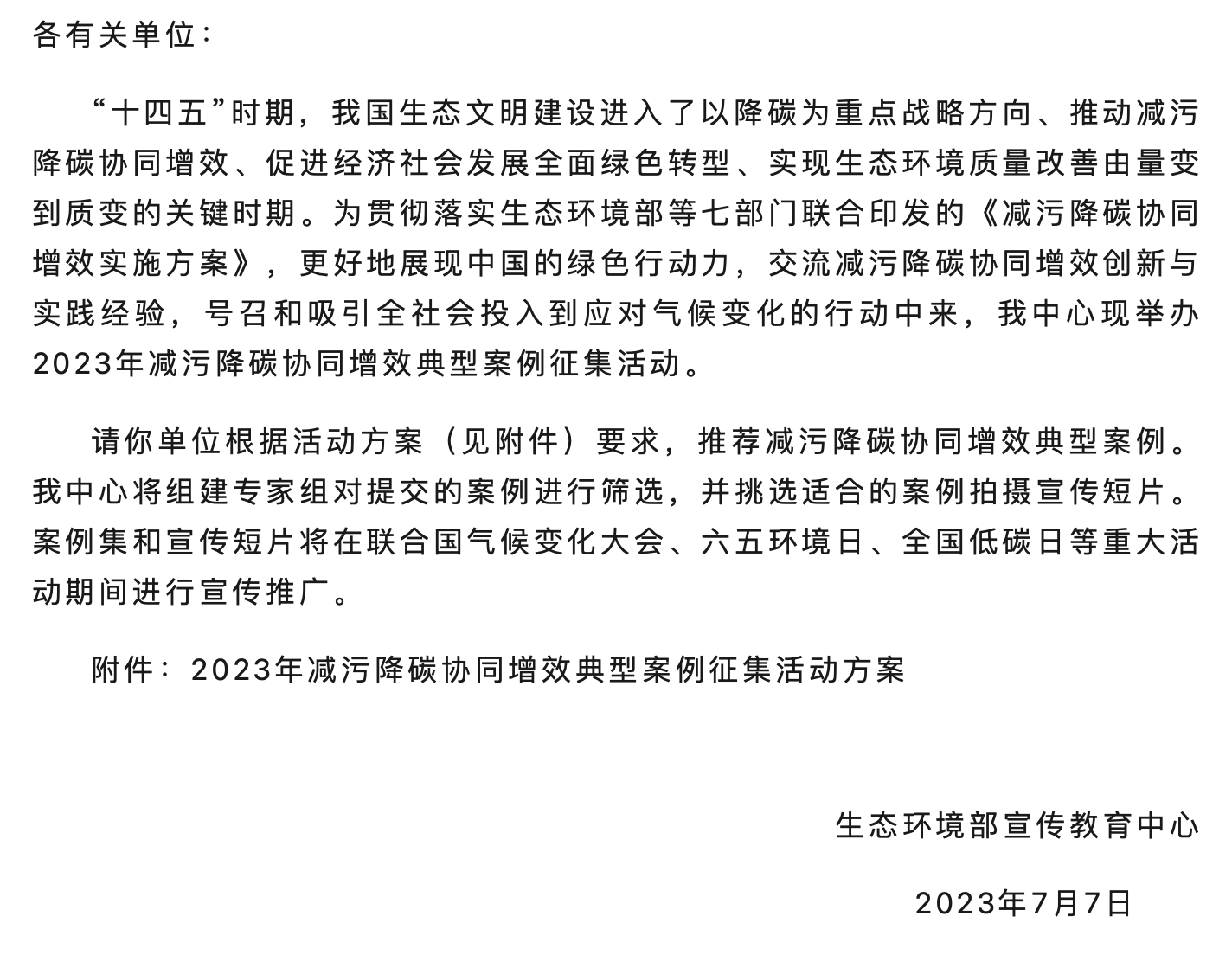
To better showcase China’s efforts in environmental protection, share innovative practices and experiences in synergistic pollution reduction and carbon emission cutting, and encourage broader societal participation in climate action, the Publicity and Education Center of the Ministry of Ecology and Environment is organizing the 2023 Call for Typical Cases of Synergistic Pollution Reduction and Carbon Emission Cutting. An expert panel will screen and evaluate the submitted cases, selecting mature technical solutions, advanced management practices, and effective models for such efforts. Suitable cases will also be featured in promotional short films, which will be disseminated during major events such as the United Nations Climate Change Conference, World Environment Day, and National Low-Carbon Day.
I. Activity Period
From July 2023 to August 31, 2023
II. Submission Requirements
Application cases must comply with relevant national laws, regulations, and policy guidelines, reflecting authenticity, practicality, growth potential, and typicality. They should promote green living and sustainable development, safeguard ecological health, foster green civilization, and establish new trends in green development. The applying entities should possess a positive social influence.
(I) Types of Applications
Type 1: Targeting communities (including urban and rural communities), industrial parks, enterprises in key industries (such as steel, power, petrochemicals, cement, etc.), associations, and non-profit organizations, this category seeks innovative practice cases that demonstrate strong influence in the coordinated reduction of pollution and carbon emissions. These cases should bring about innovation in the green revolution and exhibit representativeness, distinct features, and advantages in promoting green living, fostering sustainable development, and creating new carbon-neutral business models and approaches.
-
Energy conservation, emission reduction, green manufacturing, carbon neutrality, and other projects that achieve coordinated pollution and carbon reduction through key internal processes, technical solutions, and management measures within enterprises;
-
Innovative solutions or business models for coordinated pollution and carbon reduction developed by communities, parks, or enterprises;
-
Leadership and promotion efforts in coordinated pollution and carbon reduction carried out by non-profit organizations and industry associations.
Type 2: Focused on regions, provinces, autonomous regions, and cities, this category seeks outstanding practice cases that optimize and innovate environmental pollutant and carbon emission control technologies, approaches, policies, and systems through targeted coordination, technical coordination, pathway coordination, management coordination, and evaluation coordination. Such cases aim to achieve coordinated control of air, water, soil, solid waste pollutants, and greenhouse gases at lower costs and higher efficiency.
-
Innovative cases of coordinated pollution and carbon reduction in cities;
-
Innovative cases of coordinated pollution reduction and carbon emission cuts in provinces and autonomous regions;
-
Cases of collaborative innovation in pollution reduction and carbon emission cuts among provinces, autonomous regions, and municipalities directly under the Central Government within a region.
(II) Submission Requirements
-
Closely aligned with the theme of “Pollution Reduction and Carbon Emission Cuts through Coordination for Enhanced Efficiency,” with replicable and scalable value;
-
Tailored to local conditions, featuring regional or industry-specific characteristics, innovative formats, rich content, and demonstrating typicality and originality;
-
Having a significant social impact, being sustainable and effective, and able to fully showcase good practices in implementing green and low-carbon concepts.
(III) The project implementation timeline must meet the following requirements
-
The project started no later than January 1, 2023;
-
If the project is already completed, clear and presentable project outcomes are required.
-
If the project is still in progress but has been ongoing for 6 months, interim project outcomes are necessary (cases with only project concepts or expected results will not be considered).
III. Submission Process
(I) Typical Recommendations
By August 31, 2023.
(II) Expert Review and Public Announcement
In September 2023, experts from relevant fields will review the submitted materials, determine the list of winners, and announce them publicly.
(III) Result Announcement and Promotion
The collection of outstanding cases and promotional video on national pollution reduction and carbon emission reduction synergy will be promoted during the United Nations Climate Change Conference, the 5th Environmental Day, and the National Low-Carbon Day. It will also be exhibited in detail on platforms such as the "Micro Words for Environmental Protection" Weibo and WeChat official account of the Ministry of Ecology and Environment's publicity and education center.
4. Recommended channels and material requirements
(1) Recommended channels
By August 31, 2023, the ecological environment publicity and education departments of each province, autonomous region, municipality directly under the Central Government, planable single city, and Xinjiang Production and Construction Corps should verify and select outstanding cases within their respective regions, and serve as recommending units to submit the outstanding cases (no more than 10 of Type 1, no more than 5 of Type 2) uniformly. Please indicate the recommendation order for the recommended list.
(2) Requirements for case writing
-
For applying for a "Type 1" case, please organize the relevant modules and fill out the "2023 Outstanding Cases on Pollution Reduction and Carbon Emission Reduction Synergy Recommendation Form" (see attached);
-
For applying for a "Type 2" case, please organize according to the following content and format it in official document style, with the total text length being no less than 8,000 characters;
(1) Basic information: administrative division, geographical environment, general natural resources overview, industrial development situation, energy consumption situation, history and current status of pollutant emissions, history and current status of greenhouse gas emissions.
Exploration of collaborative innovation in pollution reduction and carbon emission cuts: innovative practices in aligning goals, technologies, approaches, management, and evaluation.
Problems and needs in collaborative innovation for pollution reduction and carbon emission cuts.
Future plans for enhanced synergy in pollution reduction and carbon emission cuts.
Policies, documents, indicators, guidelines, and other relevant materials can be provided as attachments.
-
The case content must be accurate, data must be precise, the content should be concise and focused on the theme.
-
Please provide the organization’s logo and relevant images for the case (no more than 5 images, with a resolution of at least 1920×1080 and a size of at least 4MB, in formats such as JPEG, JPG, or PNG).
(III) Submission method
For Type I applications, send the materials to dengxueqin@ceec.cn; for Type II applications, send them to chenqi@ceec.cn. The email subject should follow the format “Typical Case Recommendation Materials for Pollution Reduction and Carbon Emission Cuts in XX Province (Region/Municipality) 2023”. Include the name and contact information of the person in charge in the email. The recommendation materials must be in a separate folder, containing a scanned copy of the stamped recommendation form along with its Word version, photos (with descriptions), etc. Example file names include “Beijing XXX Recommendation Materials.zip”, “Beijing XXX Recommendation Form Scan.pdf”, “Beijing XXX Recommendation Form.doc”, and “Beijing XXX Photos (Photo Description).jpg”.
5. Other matters
-
The applicant unit must fully understand and agree to the regulations of this activity, ensure that the application materials are completely true and the data accurate, and guarantee the ownership and originality of the case. The applicant unit is the legal owner of the submitted case. If false information is found, the application qualification will be revoked.
-
The applicant unit agrees that the Environment Protection Department's Publicity and Education Center has the right to retain, copy, display, promote, publish, and publish (including electronic publication) all application materials. All submitted materials will not be returned.
6. Contact information
Type 1 case application consultation:
(010)84665711 Deng Xueqin, Li Penghui
Type 2 case application consultation:
(010)84662301 Zheng Hao