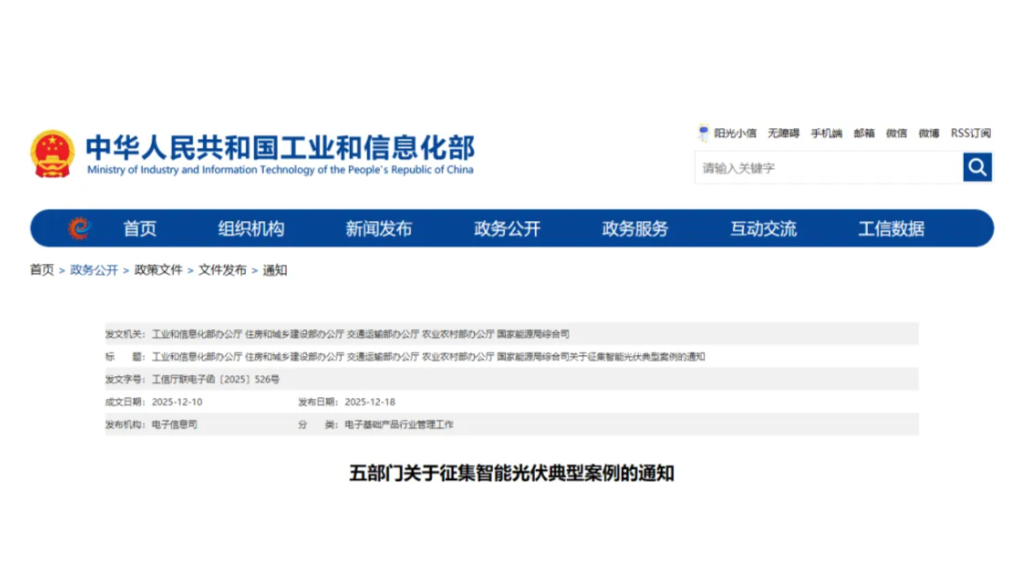
The competent departments of industry and informatization, housing and urban and rural construction, transportation, agriculture and rural areas, and energy of all provinces, autonomous regions, municipalities directly under the Central Government and cities separately listed in the plan, and the Xinjiang Production and Construction Corps: In order to further accelerate the advancement and industry application of smart photovoltaic technology, promote the deep integration of energy technology with artificial intelligence, new materials and advanced manufacturing technology, and help improve the quality and upgrade of my country's photovoltaic industry, according to the "Smart Photovoltaic Industry Innovation and Development Action Plan"(2021-2025)"(Ministry of Industry and Information Technology Joint Electronics [2021] No. 226) work deployment, the Ministry of Industry and Information Technology, the Ministry of Housing and Urban-Rural Development, the Ministry of Transport, the Ministry of Agriculture and Rural Affairs, and the National Energy Administration decided to organize the collection of typical cases of smart photovoltaic. The relevant matters are notified as follows:
1. Typical case content
Projects that apply smart photovoltaic products and integrate new generation information technologies such as 5G communications, big data, the Internet, and artificial intelligence to provide users with smart photovoltaic services. Including but not limited to:
-
Light storage fusion. Apply new energy storage technologies and products to improve photovoltaic power generation stability, grid friendliness and consumption capabilities, including photovoltaic DC systems, optical storage microgrids, rural optical storage and charging systems, portable optical storage products, etc.
-
Building photovoltaic. Including building photovoltaic projects where photovoltaic is organically integrated with buildings such as building roofs, curtain walls or sunshade, and photovoltaic power generation matches the building's electricity load.
-
Transportation applications. Including highway passenger and freight hubs, highway service areas (parking areas), gas stations, highway toll stations, maintenance work areas, ports and terminals and other scenarios, the construction of a "distributed photovoltaic + energy storage + microgrid" transportation energy system to achieve a high proportion of green electricity Self-use.
-
Agricultural and rural applications. In production scenarios such as facility agriculture, large-scale planting and breeding, and primary processing of agricultural products, develop a complementary ecological composite model of agriculture and light, and give priority to supporting qualified photovoltaic assistance projects.
-
Photovoltaic hydrogen production/ammonia/alcohol. Including the construction of a wind, solar, hydrogen/ammonia/alcohol integrated base, the synthesis of green hydrogen/green ammonia/green alcohol in chemical and other scenarios, and the realization of carbon reduction projects in transportation, industry, construction and other fields.
-
Water photovoltaic. Carry out floating photovoltaic projects in scenarios such as nuclear power warm drainage areas, salt ponds, and offshore photovoltaics to achieve the integration of multiple technologies and comprehensive utilization of resources.
-
Green photovoltaic. Including green design and green manufacturing of photovoltaic products, recycling and reuse of retired photovoltaic modules, remanufacturing of photovoltaic module parts, photovoltaic "carbon footprint" evaluation and certification, photovoltaic supply chain traceability system and other directions
-
Key information technologies. Including intelligent scheduling, intelligent operation and maintenance of photovoltaic systems, as well as communication and information systems for intelligent photovoltaic systems, flexible power electronics, smart microgrids, virtual power plants, industrial software, industrial robots, etc.
-
Advanced photovoltaic products. Including high-conversion efficiency perovskites and laminated solar cells, flexible solar cells, and related industrial chains supporting high-quality, high-reliability, low-cost equipment and materials.
-
New facilities and empirical testing. Including smart photovoltaic systems for new infrastructure such as data centers and 5G, and the construction of photovoltaic applications and empirical testing in typical scenarios such as extreme cold, extreme heat, high humidity, low radiation, and high salt fog. 2. Declaration conditions
The applicant is the case organization and implementation unit, which can be relevant application units, manufacturing enterprises, parks where the case is located, third-party integrated service organizations, etc. The relevant cases shall meet the following conditions:
-
An intelligent photovoltaic application or service system with characteristic service content and close to the actual development of the region has been built.
-
Adopt no less than 3 types of intelligent photovoltaic products (in principle, provided by enterprises meeting the Standard Conditions for Photovoltaic Manufacturing Industry (2024 edition)) or services, and provide large-scale (centralized 10MW or more, distributed 1MW or more) intelligent photovoltaic services; For single projects of intelligent photovoltaic and building integration application in buildings and towns, photovoltaic assistance projects, and highway service areas and gas stations in transportation application fields, the installed capacity shall not be less than 0.1MW;
-
Photovoltaic system installed on the building, should have emergency automatic power off function, and firmly connected with the building body, to ensure structural safety, fire safety and no water leakage, integration with other industries to ensure that the leading function is not affected;
-
It has flexible service expansion capabilities and long-term operation capabilities, an innovation model of independent innovation, continuous operation and profitability, and a development plan to continuously improve service capabilities and enrich service content.
3. Organize and implement
(1) The application unit must strictly follow the notice requirements and attachment format (which can be downloaded on the official website of the Ministry of Industry and Information Technology), fill in the typical case application form of smart photovoltaic, and submit the application materials to the local provincial industry and information technology authorities.
(2) Provincial industry and information technology authorities will conduct on-site inspections and expert reviews together with housing and urban and rural construction, transportation, agriculture and rural areas, and energy authorities, recommend enterprises and projects based on the review results, and issue recommendation letters.
(3) No more than 8 typical cases recommended by provinces, autonomous regions, and municipalities directly under the Central Government; no more than 5 typical cases recommended by cities separately listed in the plan and the Xinjiang Production and Construction Corps. The number of typical cases recommended by various places must be strictly controlled, and those exceeding the recommended number will not be accepted. (4) Local industry and information technology authorities are requested to send the recommendation letter together with the application materials (paper version in duplicate and electronic CD-ROM) to the Ministry of Industry and Information Technology (Electronic Information Division) through EMS or confidential exchange before January 20, 2026.
(5) The Ministry of Industry and Information Technology, together with the Ministry of Housing and Urban-Rural Development, the Ministry of Transport, the Ministry of Agriculture and Rural Affairs, and the National Energy Administration, will select the enterprises and projects to be declared. The selection results will be announced to the public on the official websites of relevant departments and relevant media, and enterprises and projects that have no objection to the publicity will be officially released. 4. Management and incentive measures
(1) The Ministry of Industry and Information Technology, in conjunction with the Ministry of Housing and Urban-Rural Development, the Ministry of Transport, the Ministry of Agriculture and Rural Affairs, and the National Energy Administration, will increase the publicity and promotion of typical cases, enhance the influence of typical cases, and expand the driving effect of typical cases. Organize evaluation and assessment of typical cases of smart photovoltaic and dynamically adjust the list of typical cases.
(2) Encourage government departments at all levels and all sectors of society to increase support for typical case work, and support the construction and promotion and application of typical cases from various aspects such as policies, standards, projects, and resource supporting.
68208264